
How to find podcast sponsors for a small show, step by step
Where your downloads really stand, which brands sponsor small podcasts, and a six step method to find, pitch and keep them, with 2026 numbers.
Most advice about podcast sponsors starts with "get to 10,000 downloads an episode". Most shows never will, and plenty of them still get paid by brands. They don't wait to be discovered. They find the brands that already sell to their kind of listener, and they pitch a small, easy test.
This guide is that method, written out step by step, with the numbers behind it.
The short version:
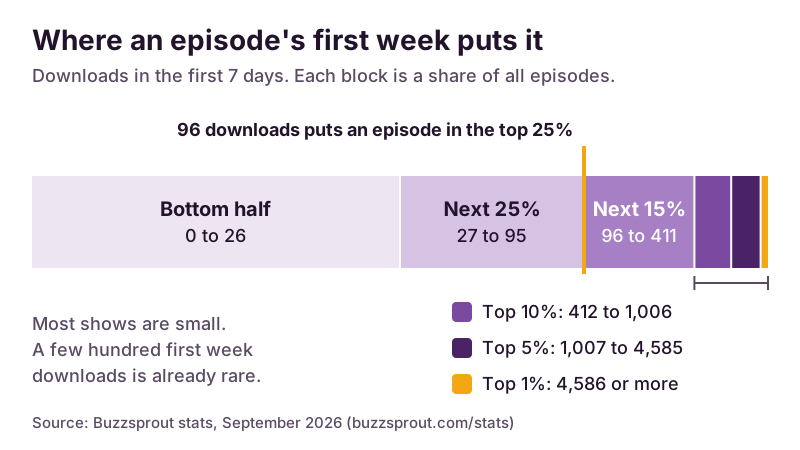
- You're probably bigger than you think. An episode with 96 downloads in its first week is in the top quarter of episodes on Buzzsprout.
- Small shows sell fit, not reach. Half of podcast ad money goes to the top 500 shows. The other half is spread across everyone else, and brands buy it for the audience.
- The best leads are brands that already sponsor shows like yours. They have a podcast budget and they know your kind of listener converts.
- Pitch a test, not a contract. Three episodes, one host read ad, a unique code. Easy to say yes to.
- Follow up once or twice, then move on. A short list of well chosen brands beats a long list of cold emails.
First, where your show actually stands
"Small" is relative, and most podcasters compare themselves to the wrong shows. Buzzsprout publishes how many downloads the episodes it hosts get in their first seven days, across more than 110,000 active shows. Here is September 2026:
| First week downloads | Where that puts the episode |
|---|---|
| 0 to 26 | Bottom half |
| 27 to 95 | Top 50% |
| 96 to 411 | Top 25% |
| 412 to 1,006 | Top 10% |
| 1,007 to 4,585 | Top 5% |
| 4,586 or more | Top 1% |
So if your episodes reach a few hundred people in their first week, they're already in the top quarter on a large host. That doesn't make sponsors easy, but it does mean "too small" is usually the wrong diagnosis. The usual problem is pitching the wrong brands, the wrong way.
The four ways podcasts get paid, and what each one needs
There are four routes to ad money. They need very different audience sizes, and they pay very differently.
| Route | What it needs | What you keep |
|---|---|---|
| Automatic ads from your host or platform | Little or no minimum. Spotify's Partner Program, which pays video podcasts, asks for 1,000 engaged listeners, 2,000 hours of listening or viewing in 30 days and 3 episodes since January 2026. | A share of programmatic ads, which sell for about $12 to $15 per thousand plays |
| Ad marketplaces (Acast, Podbean, Libsyn Ads) | Acast's marketplace starts around 1,000 monthly listeners. Podbean asks for 1,000 downloads in the last 30 days and is US only. | The marketplace keeps a cut. Libsyn Ads takes 30%. |
| Ad networks | Usually 1,000 to 5,000 downloads an episode, often more | Networks commonly keep 30% to 40% |
| Direct sponsors you find and sign yourself | No formal minimum. Acast puts the realistic start at 5,000 to 10,000 downloads for general shows, and earlier for niche business, finance and professional shows. | All of it. Host read ads sell for about $24 to $40 per thousand downloads. |
Two things stand out.
Automatic ads are easy and cheap. At $15 per thousand plays, an episode with 400 downloads earns at most $6. That's fine as a bonus, but it won't pay for your editing.
Direct deals are where small shows win, especially in a niche. A brand that sells accounting software doesn't care that you have 800 listeners if they're 800 small business owners. You keep the whole fee, and you control which brands your listeners hear.
One more reason to learn the direct route now: Audacy's Creator Lab, built on the Podcorn marketplace, closes on November 1, 2026. It was one of the few places that matched shows with a few thousand downloads to brands with no minimum. That route is gone.
Why a small show can still win a direct deal
Brands keep spending more on podcasts. US podcast ad revenue reached $2.86 billion in 2025, up 17.6% on the year before, according to the IAB and PwC. Magellan AI counted 1,297 brands advertising on podcasts for the first time in the second quarter of 2026 alone.
Much of that money goes to the biggest shows. Magellan found the top 500 shows took 48% of ad spend in the first quarter of 2026 and 52% in the second. That leaves the other half for everyone else, and brands buying outside the top 500 are buying an audience, not a household name.
Two more findings help your case:
- Sales beat size. Oxford Road, an agency that buys podcast ads for direct response brands, ranked shows by the sales they actually drove across about $1.6 billion of spend. A tabletop gaming show came first, and none of the top 15 were the giant shows you'd expect.
- Host reads persuade. In The Podcast Study 2026, 40% of listeners said host read ads strongly influence them to try or buy, against 27% for prerecorded ads. Small shows almost always read their own ads.
Your pitch, then, isn't "I have a big audience". It's "I have the right audience, and they trust me".
Step 1: List 10 shows your listeners also hear
Start with the shows that share your listeners, not just your topic. A show about running and a show about meal prep can share far more listeners than two running shows with different tones.
Ways to find them:
- Ask your listeners. One question in an episode or newsletter: "What other podcasts do you never miss?" Even 20 answers will show a pattern.
- Look at the "you might also like" rows on your show's page in Apple Podcasts and Spotify. They come from what your listeners actually play.
- Check your guests and theirs. Shows that book the same guests usually serve the same people.
- Read your reviews and comments for other shows people mention.
Aim for a mix of sizes: a few shows like yours, and a few that are two to ten times bigger. Bigger shows have more sponsors to learn from, and their sponsors often look for more shows like them.
Step 2: Find out who already sponsors those shows
This is the most valuable hour you'll spend. A brand that sponsors three of the shows on your list has a podcast budget, a person who buys podcast ads, and evidence that your kind of listener buys from it.
For each show, open the last 20 episodes and read the show notes. Sponsored episodes usually say so: "This episode is brought to you by", "Use code", "Go to brand.com/show". Write each one down.
| Brand | Show | Episodes seen | Code or link | Last seen |
|---|---|---|---|---|
| Example: a meal kit | A cooking show | 6 of the last 20 | SHOWNAME20 | Last week |
What to watch for:
- Repeat sponsors. A brand that keeps coming back to the same show is getting results there. That's the strongest signal you'll find.
- Brands on several of your shows. They're buying an audience, and it's yours.
- Empty show notes on big shows. Many large shows insert ads automatically at download time, so the ads never appear in the notes and differ by listener. If a big show lists no sponsors, listen to one midroll instead of assuming it has none.
Step 3: Add brands your listeners already love
Proven sponsors are your warmest leads, but they're not the only ones. Some of the best fits have never sponsored a podcast, because nobody showed them an audience like yours.
Three quick ways to find them:
- Run a three question listener survey. Ask which brands they bought from recently in your topic, which apps or tools they use every week, and what they wish existed. Put the link in two episodes.
- Add each proven sponsor's competitors. If one meal kit sponsors your similar shows, the other meal kits are worth a look.
- List what you already use. A product you genuinely use makes the easiest ad read you'll ever do.
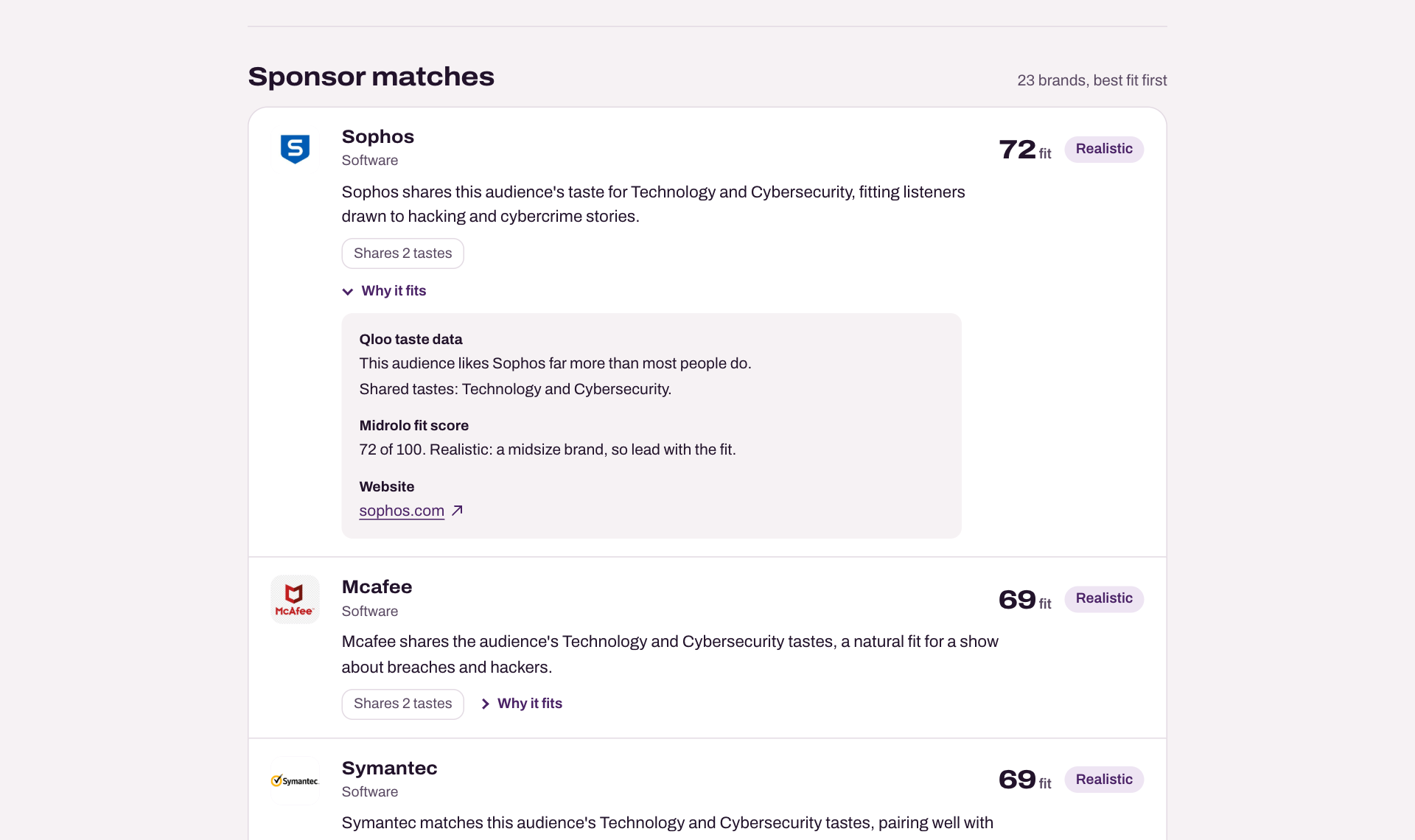
This is also where taste data helps. People who share a taste in one area tend to share tastes in others: the listeners of a true crime show may also follow certain cooking creators, travel brands or fashion labels. Midrolo uses Qloo's taste data to build exactly this kind of profile for a show's listeners, then ranks brands by how closely they match it.
Step 4: Cut the list down to 15
You'll likely have 30 to 60 brands by now. Pitching all of them at once spreads you thin. Keep the 15 that pass most of these checks:
- It sells where your listeners live. A brand that only ships in the UK won't buy a show with mostly US listeners.
- Its price fits your listeners. A luxury brand needs listeners who buy luxury.
- It already uses codes, affiliate links or creator partnerships. It knows how to measure you.
- You'd recommend it without being paid. Listeners hear the difference.
- It doesn't compete with a sponsor you already have.
- You can find a person to email: a partnerships address, a head of growth or a marketing lead.
Rank the 15 by how strong the evidence is: proven sponsors of shows like yours first, then brands your listeners named, then the rest.
Step 5: Write a short pitch that's about them
Brand teams get a lot of pitches. The ones that work are short, specific and easy to say yes to. Lead with why this brand, then who your listeners are, then a small offer.
Here's a template to adapt:
Subject: [Show] listeners and [Brand]: a three episode test?
Hi [Name],
I host [Show], a weekly show about [topic] for [who they are]. I noticed [Brand] sponsoring [Similar Show], and a lot of our listeners also listen to [Similar Show].
A few things about our listeners:
- [Something specific about their tastes or habits that fits the brand]
- [Where they are: for example, mostly in the US and Canada]
- [A sign they act on what they hear: survey replies, a past code's results, community size]
I'd like to suggest a small test: a 60 second host read midroll in three episodes over six weeks, with your own code and link so you can see exactly what it drives. The price is [$X] for all three.
Our media kit, with rates and audience details: [link]
Is this worth a quick call, or is there someone else on your team I should send it to?
[Your name]
Why this shape works:
- The first line proves you did your homework. Naming a show they already sponsor tells them you understand their buyer.
- The listener lines replace a demographics deck you don't have. Tastes and habits are often more persuasive than age brackets.
- The offer is a test with its own measurement. It's cheap to approve, and the code means the results are theirs to see.
Keep it under 200 words. Send it from your own address, not a bulk email tool, and put the media kit behind a link rather than an attachment.
Step 6: Follow up, then run a test worth renewing
Most first emails get no reply because they arrive on a busy day, not because the answer is no. Follow up once after about a week, and add something new each time: a recent episode that fits their product, a new listener number, a listener quote. If there's still nothing a week or two later, send a short, friendly close and move to the next brand.
Subject: Re: [Show] listeners and [Brand]
Hi [Name], one more thought: our episode on [topic] this week fits [Brand] well, and [one new fact]. Happy to hold a slot in November if a test makes sense. Thanks either way!
When a brand says yes, treat the first deal as a test you want to turn into a renewal:
- Agree on how results are counted. A unique code and a short link to a page for your listeners are the minimum. Brands usually judge a test over two to six episodes and about two to three months.
- Read the ad like you mean it. Brands give talking points so the host can make the read their own. Use them.
- Send a short report. Downloads per episode in the first 30 days, any listener feedback, and a thank you. It makes the renewal conversation easy.
- Say clearly that it's an ad. "This episode is sponsored by" in the audio itself, every time. It's what the FTC expects, and listeners trust you more for it.
Your checklist for this week
- List 10 shows your listeners also hear.
- Read 20 episodes of show notes for each and log every sponsor.
- Add 10 brands from a listener survey, competitors and your own habits.
- Cut the list to 15 and find a person to email at each.
- Send five pitches. Follow up in a week.
- Put your rates and audience on one page you can link to.
How Midrolo helps
Midrolo does the research half of this for you. Give it your show and it:
- finds shows whose listeners share your listeners' tastes, using Qloo's taste data;
- reads their recent episodes for sponsor reads, so you see which brands already buy shows like yours;
- ranks brands by how well they fit your listeners, with the evidence behind each one;
- writes a pitch email for each brand, priced from your rate card, and builds a media kit page you can link to.
Here's what that looks like on a public sample report:
You can read the full sample reports without signing up, or start with a free Snapshot of your own show. The next guide covers what to charge once a brand says yes.
Sources
- Buzzsprout, podcast statistics: first week downloads, September 2026.
- Acast, how many listeners you need to monetize a podcast, October 2026.
- TechCrunch, Spotify lowers its monetization threshold, January 2026.
- Podbean, joining the ads marketplace.
- Libsyn Ads, advertiser FAQ, 2026.
- Castos, podcast ads guide, 2026.
- Radio Ink, Audacy to close its Creator Lab podcast platform, August 2026.
- Radio Ink, IAB and PwC internet advertising revenue report, April 2026.
- Magellan AI, podcast advertising benchmarks, Q2 2026.
- Podcasting Today, Oxford Road's podcast rankings based on sales data, October 2025.
- Net Influencer, The Podcast Study 2026 on ad load and host reads, 2026.
- FTC, Endorsement Guides: what people are asking.