
How much to charge for a podcast ad in 2026, with a rate card you can copy
Real 2026 ad rates by type, the math for small shows, flat fees and per sale deals, plus a rate card, media kit and deal terms you can send to brands.
A brand just replied "What are your rates?" and you're staring at the email. Published rate guides contradict each other, the numbers you find are for shows ten times your size, and pricing too high or too low both feel like ways to lose the deal.
This guide gives you a number you can defend: how podcast ads are priced, what brands actually pay in 2026, what to do when the standard math gives you pocket change, and a rate card, media kit and set of terms you can send today.
The short version:
- Most podcast ads are priced per thousand downloads (CPM). Host read ads sit around $24 to $40 per thousand in 2026 rate cards.
- Price = CPM × downloads per episode ÷ 1,000. Use your average downloads in each episode's first 30 days, not lifetime totals.
- Below about 5,000 downloads, charge a flat fee with a sensible floor, and sell packages instead of single reads.
- Sell a test first: three or four episodes, a unique code and a short report. Price it so you'd happily repeat it.
- Put your rates in your media kit. A kit without prices adds a round of email before anyone can say yes.
How podcast ads are priced
Almost every podcast ad deal starts from CPM, the cost per thousand downloads:
Price per read = CPM × downloads per episode ÷ 1,000
So a show with 5,000 downloads an episode at a $25 CPM charges $125 for one read.
"Downloads per episode" has a standard meaning that brands will expect: the average number of downloads an episode gets in its first 30 days, taken over your last 10 episodes. Not lifetime downloads, and not your best episode. Overstating it is the fastest way to lose a renewal, because the brand's code results will show the truth.
Here's what the formula gives at common sizes and rates:
| Downloads per episode | at $18 CPM | at $25 CPM | at $35 CPM |
|---|---|---|---|
| 500 | $9 | $12.50 | $17.50 |
| 1,000 | $18 | $25 | $35 |
| 2,500 | $45 | $62.50 | $87.50 |
| 5,000 | $90 | $125 | $175 |
| 10,000 | $180 | $250 | $350 |
| 25,000 | $450 | $625 | $875 |
The top of that table is why so many small podcasters give up on sponsors. We'll fix that below.
What brands pay in 2026, by type of ad
Not all ads are worth the same. The biggest difference is between ads you read yourself and ads a computer inserts.
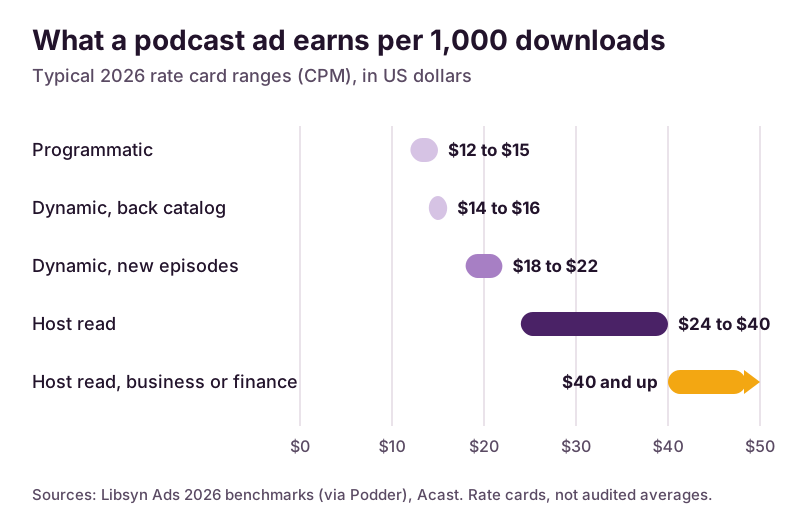
| Ad type | Typical CPM in 2026 | What it is |
|---|---|---|
| Programmatic | $12 to $15 | Ads placed by software across many shows, targeted by data |
| Dynamic insertion, back catalog | $14 to $16 | Ads stitched into old episodes at download time |
| Dynamic insertion, new episodes | $18 to $22 | The same, in the latest episodes |
| Host read | $24 to $40 | You read it, in your own words, often recorded into the episode |
| Host read, niche business or finance | $40 and up | Specialist audiences that are expensive to reach anywhere else |
Libsyn's marketplace puts the average host read at $24 to $26, and Acast quotes $25 to $40. Topic matters too. Libsyn's 2026 figures by category:
| Category | Average CPM |
|---|---|
| Business | $30 |
| Health and fitness | $27 |
| Technology and education | $26 |
| Fiction | $24 |
| Science, comedy and society | $23 |
| Games and leisure | $22 |
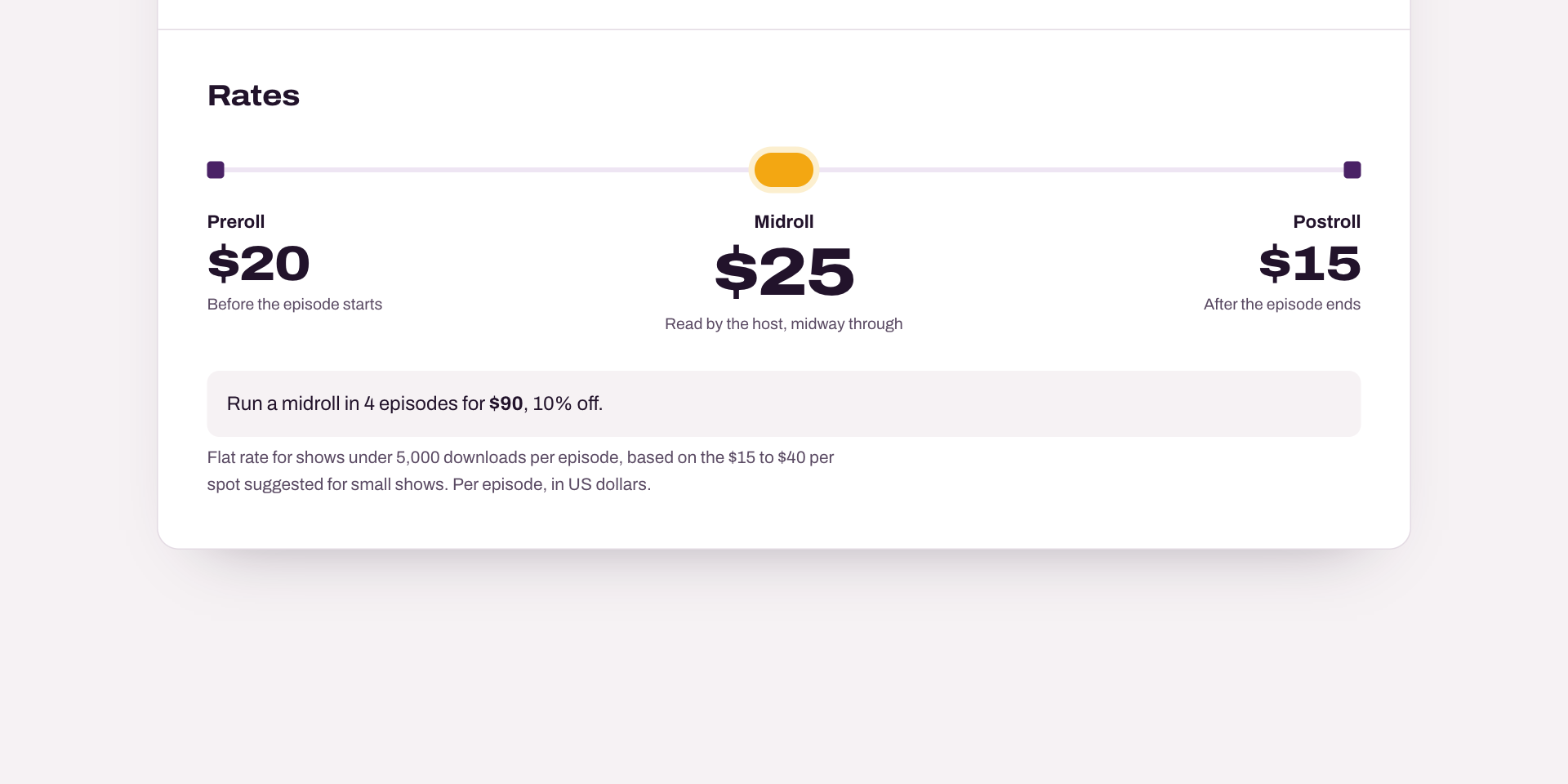
Where the ad sits matters as well. Most rate cards price the midroll highest, since listeners are settled in. The preroll is usually a little lower, and the postroll much lower, because many people stop before the end. One agency, Ad Results Media, gave about $20 for a preroll, $25 for a midroll and as little as $1 to $5 for a postroll.
A word of caution: these are rate card numbers that vendors publish, not audited averages, and sources disagree. Treat them as a range to position yourself in, not a price list.
Why the math breaks for small shows
Run the formula on a typical independent show. An episode with 300 downloads at a $25 CPM is worth $7.50.
Nobody is going to sign a contract, set up a promo code and build a landing page for $7.50, and you shouldn't write, record and report on a read for it either. The brand's work to set up a sponsorship is about the same whether you have 300 listeners or 30,000.
That's why small shows that do get paid rarely sell single reads at CPM. They use one of three models instead.
Three ways to price below 5,000 downloads
1. A flat fee per read, with a floor
Charge a fixed price per episode instead of a CPM. Podcast pricing guides suggest switching to flat fees when you deliver fewer than about 5,000 downloads an episode, or when your numbers swing a lot from episode to episode.
Set a floor: the lowest price at which a read is worth your time to write, record and report on. Then price above the floor as you grow.
For reference, this is the rule Midrolo uses for its suggested rates. It's simple on purpose, so you can explain it to a brand:
- Under 5,000 downloads: $25 per thousand downloads, with a $25 minimum per read, rounded to the nearest $5.
- At 5,000 and up: a $25 CPM.
- Niche topics pay more: about 50% more for business, finance, investing and technology shows, and 20% more for health and education.
- Preroll at 80% of the midroll price, postroll at 50%.
- Four episode packages at 10% off.
2. Pay per result
In a CPA or affiliate deal, the brand pays for each sale or sign up that comes through your code or link, instead of for downloads. Small shows with loyal listeners can earn more this way than at CPM, because a trusted host converts well.
The catch: you carry the risk. If the product is a poor fit or the landing page is weak, you earn nothing. There's no reliable public benchmark for podcast CPA rates, so ask the brand:
- What do they pay other creators per sale or sign up?
- How long does your code stay active? Recorded reads keep selling from your back catalog for months.
- Can you see the results, not just the payout?
3. A hybrid, and packages
The safest middle ground is a small fixed fee plus a bonus per sale. You're paid for the read either way, and you share the upside when it works.
Whatever the model, sell packages, not single reads. A test of three or four episodes gives the brand enough data to judge, and gives you a real chance at a renewal. Then add extras at a separate price:
- Exclusivity: no competing brands for a set time. Price it separately; it costs you other deals.
- A longer or custom read, a dedicated segment or a product review episode.
- Mentions elsewhere: your newsletter, social posts or show notes.
How to set your number in five steps
- Find your real number. Average the first 30 days of downloads across your last 10 episodes.
- Pick a CPM. $25 is a sound default for a host read midroll. Go higher in business, finance and professional niches, and a little higher in health and education.
- Do the math, then apply your floor. If the formula gives less than your floor, charge the floor.
- Build three packages: a single read, a four episode test and a quarter. Discount the longer ones a little.
- Raise prices when brands renew. A renewal is proof the read works. Raise your price for new sponsors first.
A rate card you can copy
Here's what Midrolo's rule suggests for a few typical shows:
| Show | Midroll | Preroll | Postroll | Four episode test |
|---|---|---|---|---|
| 300 downloads, general topic | $25 | $20 | $15 | $90 |
| 3,000 downloads, general topic | $75 | $60 | $40 | $270 |
| 3,000 downloads, business | $115 | $90 | $60 | $414 |
| 8,000 downloads, health | $240 | $192 | $120 | $864 |
And a simple card to adapt for your own show:
| Package | Includes | Price |
|---|---|---|
| Single read | One 60 second host read midroll, your code and link | $[your midroll] |
| Test pack | Four midrolls over eight weeks, code and link, a results report at 30 days | $[4 × midroll, less 10%] |
| Quarter | Twelve midrolls, a mention in each episode's show notes, a report each month | Quote |
| Add ons | Preroll, newsletter mention, exclusivity in your category | Quote |
Lead with the test pack. It's the easiest yes for a brand that has never bought your show.
What to put in your media kit
Your media kit is the page you link in every pitch. Brands skim it in a minute or two, so put the answers they need where they'll see them.
What to include:
- The cover: show name, artwork, one line on who it's for, and one headline number.
- Who listens: their life stage, interests, where they live, and what they buy. If you don't have survey data, describe their tastes: the brands, shows and creators they love.
- Your numbers: downloads per episode in the first 30 days, averaged over your last 10 episodes, plus how often you publish and how fast you're growing.
- Proof: reviews, listener messages, community size, and results from past sponsors if you have them.
- Packages and prices, from your rate card.
- How results are tracked: a unique code, a short link and a report after 30 days.
- A professional contact email.
Common mistakes that make brands move on:
- Leading with lifetime downloads instead of per episode numbers.
- Writing about you instead of the listener the brand wants to reach.
- No prices.
- A PDF attachment instead of a link. Links get opened, and you can update them.
- Stale numbers. Refresh the kit every three months.
You can see a full sample media kit here.
Agree on the terms before the first read
A short email that confirms these points saves most of the arguments sponsors and podcasters have:
- The deal: price, number of reads, which episodes or dates, placement (midroll) and length (60 seconds).
- The read: talking points or a script, and whether the brand approves the read before it goes out.
- Tracking: the code, the link, and which numbers you'll report and when.
- Make goods: what happens if an episode is late or a read has a mistake. An extra read is the usual fix.
- Exclusivity: which competitors, for how long, and at what price.
- Recorded in or inserted: whether the read stays in the episode for good or comes out after the campaign.
- Payment: when you invoice and when you're paid. Net 30 is common with brands that buy direct; agencies often pay more slowly.
This isn't legal advice. For a large or long deal, a written agreement is worth the effort.
Disclose every sponsored read
US rules require you to tell listeners when you're paid to talk about a product. The FTC's Endorsement Guides ask for disclosure that is clear and hard to miss. For a spoken ad, that means saying it out loud, not just writing it in the show notes.
- Say it plainly: "This episode is sponsored by [Brand]." No special wording is required, but listeners must not be able to miss it.
- Disclose commissions too. If you earn from a code or link, say so: "I earn a commission when you use my code." The FTC says words like "affiliate link" alone aren't clear enough.
- Free products count. A product the brand sent you for free is a connection worth disclosing.
Disclosure doesn't hurt the read. Listeners already know you have sponsors; what they want to know is that you're being straight with them.
Keep the ads few and good
Listeners are getting tired of ads. In The Podcast Study 2026, 55% of listeners said podcasts already have too many ads, and fewer than 9% said they'd accept more. Magellan AI measured the average ad load at 8.75% of episode time in mid 2026, up from the quarter before.
The same study found 40% of listeners say host read ads strongly influence them to try or buy, against 27% for prerecorded ads. So the winning move for a small show is simple: one or two well matched host reads per episode, priced fairly, rather than as many slots as you can sell. That's what keeps listeners, and what keeps sponsors renewing.
How Midrolo helps
Midrolo builds the pieces in this guide from your show's RSS feed:
- A rate card from your downloads and topic, using the rule above. Change any figure you like.
- A media kit page with your numbers, your rates and your listeners' tastes from Qloo's taste data, so you have something to show brands even without a demographics survey.
- Pitch emails for brands that fit your listeners, each with an offer priced from your rate card.
New to sponsorship? Start with how to find sponsors for a small show, then look at a sample report or run a free Snapshot of your own show.
Sources
- Podder, podcast sponsorship pricing, citing Libsyn Ads 2026 benchmarks, August 2026.
- Libsyn Ads, advertiser FAQ, 2026.
- Acast, how much podcast advertising costs.
- Ad Results Media, how much podcast ads cost, May 2025.
- MillionPodcasts, the podcast media kit sponsors want, August 2026.
- FTC, Endorsement Guides: what people are asking.
- Promise Legal, podcast sponsorship disclosure and the FTC rules for audio, July 2026.
- Net Influencer, The Podcast Study 2026 on ad load and host reads, 2026.
- Magellan AI, podcast advertising benchmarks, Q2 2026.